

PointsCrowd is a community-supported platform. When you apply for a credit card, make an order, or otherwise interact with the advertisers through the links on this page we may earn an affiliate commission. This helps us maintain and develop the platform further at no cost to you.
Wyndham Rewards’ simple three-tier award chart is gone. As of September 15, 2026, redemptions across Wyndham’s roughly 8,400 hotels now fall into four fixed point tiers instead of three — and while the cheapest rooms actually got cheaper, the new top tier pushes the most expensive properties 50% higher than before.
What Exactly Changed

Since 2019, Wyndham had one of the simplest award charts in the hotel industry: every property cost 7,500, 15,000, or 30,000 points a night, full stop. That three-tier system is now retired. In its place, Wyndham has a four-tier chart, and every one of its roughly 8,400 hotels has been re-sorted into one of the new tiers.
The New Wyndham Award Chart
| Old Chart (2019–2026) | New Chart (Since Sept 15, 2026) | |
|---|---|---|
| Lowest tier | 7,500 points/night | 5,000 points/night |
| Second tier | 15,000 points/night | 15,000 points/night (unchanged) |
| Third tier | 30,000 points/night | 30,000 points/night (unchanged) |
| New top tier | Did not exist | 45,000 points/night |
The middle two tiers didn’t move at all — 15,000 and 30,000 points are exactly what they were before. The real story is at the edges: the entry-level tier dropped from 7,500 to 5,000 points (a 33% cut), while an entirely new 45,000-point tier appeared above the old 30,000-point ceiling, a 50% jump for whatever properties land there.
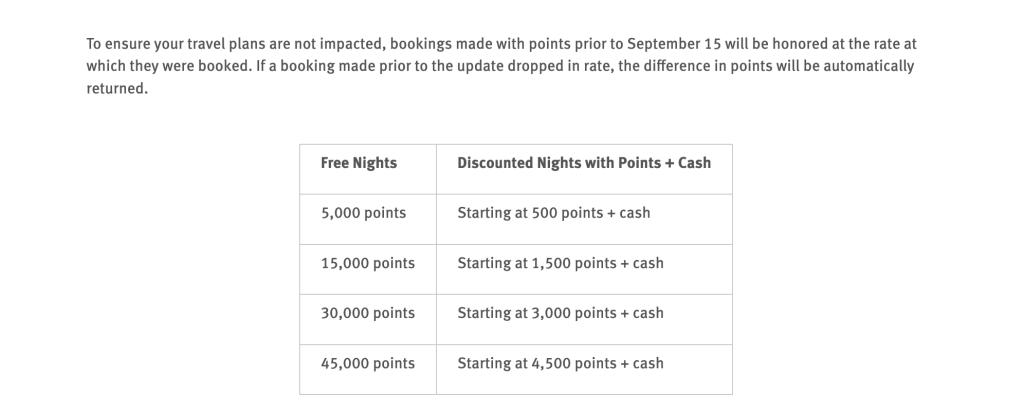
Wyndham itself says the shakeout affected “thousands” of properties in both directions — some moved up a tier, some moved down — though the company says the bulk of its portfolio still sits across the three lower tiers (5,000/15,000/30,000). Independent tallies of the chart found that roughly 34% of hotels ended up costing more points, 22% got cheaper, and 44% landed at the same price they were before.
Why Wyndham Says It Made the Change

Wyndham’s official explanation is straightforward: its hotel portfolio has changed since the three-tier system launched in 2019, and pricing needed to catch up. The company points specifically to the addition of “hundreds of luxury, lifestyle, and all-inclusive hotels” — brands like Alltra, Vienna House, and Registry Collection resorts — that never fit cleanly into a chart topping out at 30,000 points. The new 45,000-point tier gives Wyndham a place to put those properties without distorting pricing for the budget and midscale hotels that still make up most of the portfolio.
Why Many Travelers See This as a Devaluation
Points-and-miles outlets are largely calling this a devaluation, and the math backs that up in aggregate: more hotels got more expensive (34%) than got cheaper (22%). It’s the same playbook Hyatt ran with its own award chart expansion — add a new top tier, frame the cheaper entry-level rooms as the headline, and let the most desirable properties quietly cost meaningfully more. A cheaper Super 8 doesn’t offset a Wyndham Grand resort jumping from 30,000 to 45,000 points a night if the resort is the one you actually wanted to book.
Cash + Points Also Shifted
The point-plus-cash discount option got restructured alongside the core chart, since it’s calculated as a discount off each tier’s full price. The new range runs from as little as 500 points plus cash at the bottom tier up to 9,000 points plus cash for a night at the new 45,000-point top tier — a wider spread than the old chart supported, but proportionally similar to how the discount worked before.
Who Comes Out Ahead, and Who Doesn’t

- Budget and midscale travelers win outright. Brands like Super 8, Days Inn, Microtel, and Howard Johnson properties that priced at 7,500 points now cost 5,000 — a real 33% savings for the exact same room, with no catch.
- Travelers chasing Wyndham’s nicest properties lose the most. Wyndham Grand resorts, Registry Collection properties, and all-inclusive Alltra and Viva resorts in the Caribbean are the properties most likely to have landed in the new 45,000-point tier — a straight 50% increase over the old 30,000-point ceiling.
- Most travelers land in the middle, genuinely unaffected. With 44% of hotels unchanged and the two middle tiers frozen at 15,000 and 30,000 points, a large share of typical Wyndham stays cost exactly what they did before September 15.
What This Means for Your Booking Strategy Now
The window to lock in the old chart closed on September 15, so the useful move now is simpler: check where your specific target property landed before you book. A hotel that used to sit at the 30,000-point ceiling could now be priced at 30,000, or it could have jumped to 45,000 — there’s no way to know without looking it up, since Wyndham redistributed “thousands” of properties in both directions rather than moving every top-tier hotel uniformly. If a stay you already booked before the change dropped to a cheaper tier, Wyndham says it will automatically refund the point difference — no action needed on your end.
If you’re holding a large Wyndham balance with no specific redemption planned, this is also a reasonable moment to check whether those points still make sense sitting in Wyndham’s program at all — see Convert Wyndham Points to United Miles for one way to move a balance out rather than watch it get squeezed by the next chart revision.
Bottom Line
Wyndham’s new four-tier award chart is a mixed bag dressed up as a simplification: budget and midscale stays got a genuine 33% cheaper, but the introduction of a 45,000-point tier means the nicest properties in the portfolio now cost 50% more than they did before September 15, 2026. With 34% of hotels pricier, 22% cheaper, and 44% unchanged, the honest takeaway is that this helps casual travelers booking economy hotels and hurts anyone who was saving points for a resort-level stay — check where your specific property landed before you book.


